The landscape of American higher education is undergoing a seismic shift. By 2026, the integration of Artificial Intelligence (AI) and Educational Technology (EdTech) has moved beyond mere trendiness to become the foundational architecture of academic inquiry. From the Ivy League corridors of the East Coast to the tech-centric research hubs of California, the definition of “rigorous research” is being rewritten by algorithms that can synthesize decades of data in seconds. This transformation isn’t just about speed; it’s a fundamental change in what is expected of a doctoral candidate and the nature of original research itself.
The Cognitive Shift: Balancing Innovation and Integrity
At the heart of this transformation is the Science of Cognitive Load. As students and doctoral candidates are bombarded with an exponential increase in digital information, the mental effort required to process, categorize, and synthesize data has reached a breaking point. Cognitive Load Theory (CLT) suggests that our working memory has a limited capacity; when academic demands exceed this capacity, learning and original thought are stifled.
In the modern US university setting, EdTech tools are no longer just “helpful” additions; they are cognitive prosthetics. These systems allow researchers to offload lower-level, highly demanding tasks—such as citation formatting, initial literature screening, and basic data cleaning—to focus on high-level critical analysis and creative hypothesis generation.
However, this technological surge brings a new set of challenges. US universities are now grappling with what many call the “Verification Crisis.” When an AI can generate a plausible hypothesis or draft a literature review, the value of the human researcher shifts from production to validation. Scholars must now demonstrate a level of nuance, ethical oversight, and contextual understanding that machines cannot replicate. The standard has been raised, forcing researchers to prove that their human interpretation adds value that an algorithm cannot. To navigate these heightened expectations and to bridge the gap between human insight and technological efficiency, many scholars seek specialized, human-led support. Utilizing professional Dissertation Writing Services in the USA has become a strategic move for students who need to ensure their work meets these evolving, tech-augmented standards of excellence while maintaining the highest levels of academic integrity and original thought.
Data-Driven Research: The New American Standard
The 2026 academic year has seen a definitive move toward “Computational Humanities” and data-heavy STEM research. Recent statistics indicate that nearly 72% of US graduate students now utilize some form of AI-driven research assistant for predictive data modeling. This shift toward quantitative precision is undeniable, even in traditionally qualitative fields. Research is no longer just about the “narrative”; it is about the “nexus”—the point where big data meets human insight.
The modern dissertation is no longer a static document. It is often a multimodal project, incorporating interactive data visualizations, live code repositories, and dynamic bibliographies that update in real-time. In this environment, a student is judged not just on their writing and argumentative skills, but on their “Digital Fluency”—their ability to seamlessly integrate and command a powerful suite of technological tools.
Visualizing the Shift: 2024 vs. 2026
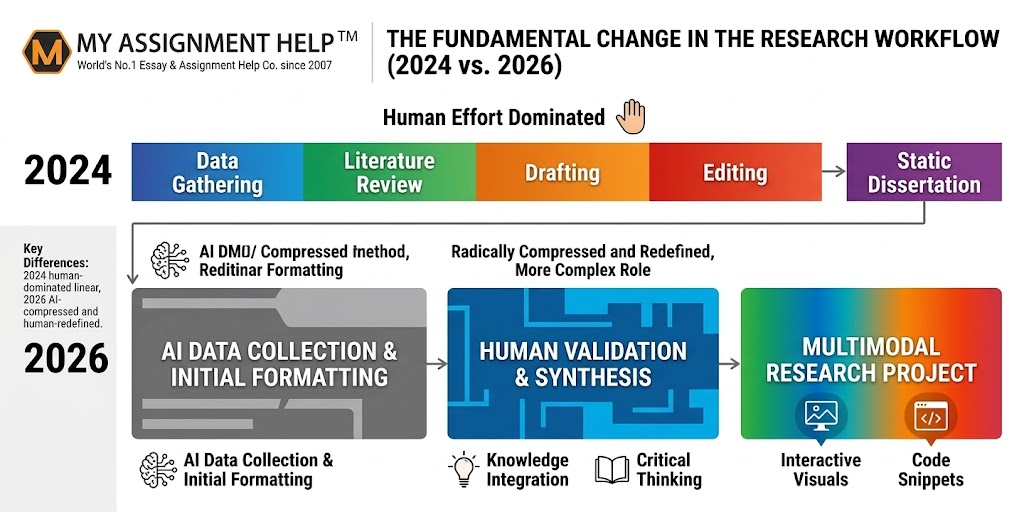
To understand the scale of this change, we must look at the mechanical and strategic differences in how research is conducted today versus just a few years ago.
Figure 1: Diagram Showing the Shift from 2024 to 2026 Standards
| Research Feature | Traditional Standard (Pre-2024) | Redefined Standard (2026) |
| Data Processing | Manual Coding & Basic Spreadsheets | AI-Powered Predictive Analytics & Automated Verification |
| Literature Review | Keyword-based Search (Boolean), relying on human curation | Semantic & Contextual AI Mapping, identifying hidden connections |
| Time to Hypothesis | 3–6 Months of Exploratory Reading & Sifting | 2–4 Weeks of Synthesized Analysis & AI-Driven Ideation |
| Primary Evaluative Metric | Volume of Citations & Comprehensive Coverage | Critical Synthesis, Original Insight, & Ethical Validation |
| Output Format | Linear PDF/Print Document, static and final | Multimodal/Interactive Digital Assets, dynamic and updateable |
The “Proposal” Hurdle in a Tech-First World
The very first step of the doctoral journey—the dissertation proposal—has become significantly more complex. In the US, departmental committees now expect a level of data visualization and preliminary analysis that was previously reserved for final defenses. The proposal must demonstrate not just a gap in the literature, but a technical roadmap and a functional “Proof of Concept,” outlining how that gap will be bridged using modern EdTech stacks.
Because the technical bar has been raised so high, and the expectation for sophisticated project management has grown, the trend to buy dissertation proposal assistance has seen a marked increase among US students. This isn’t about bypassing the hard work; it’s about securing a professional blueprint and methodology that aligns with modern, data-heavy departmental requirements. A well-structured proposal acts as a “Proof of Concept,” ensuring the student has a viable path forward before committing years to a project that might otherwise be rendered obsolete by rapid technological shifts.
The Role of LLMs in Scholarly Writing
Large Language Models (LLMs) have fundamentally changed the “Drafting Phase” of scholarly writing. In US universities, the emphasis has shifted from the mechanical process of “How do I say this?” to the far more complex questions of “Is what I am saying accurate, significant, and backed by verifiable data?” This has led to a rise in “Socratic Research,” where the student uses AI tools to stress-test their arguments and explore counterarguments before they ever reach their advisor’s desk.
However, the risk of “Algorithmic Bias” remains a primary concern for US faculty. Students are now required to submit “AI Transparency Statements” alongside their research, detailing precisely which tools were used, for what purposes, and how the output was verified. This process ensures that while technology handles the heavy lifting of data organization, the human researcher remains the ultimate authority, accountable for the accuracy and significance of the findings.
Cognitive Load and Mental Health in Grad School
The “2026 US Higher-Ed Crisis” is not just about technology; it’s about the human cost of academic rigor. The pressure to master both a specialized subject area and a complex suite of technical tools has led to record levels of doctoral burnout and advisor fatigue. This is where the intersection of EdTech and human support becomes vital for sustainability.
By utilizing expert consultancy and professional writing services, students can manage their cognitive load more effectively. It allows them to delegate the structural and formatting intricacies of a 300-page document to professionals, freeing up their mental “bandwidth” to focus on the truly innovative experiments and theoretical breakthroughs that will define their dissertation and their future careers.
See also: How to Design a Beautiful Backyard
Ethical Considerations and the Future of Peer Review
As we move deeper into 2026, the US peer-review process is also evolving. Major academic journals and university libraries are beginning to utilize “AI-Reviewer Bots” to check for data consistency, hidden formatting errors, and potential plagiarism at a granular level. For a student submitting their dissertation, this means there is zero margin for error. A single incorrectly cited data point or a mismatched variable can lead to immediate rejection or a requirement for extensive and stressful revisions.
This “Zero-Error Culture” is why professional proofreading and dissertation formatting services have transitioned from being a luxury to an absolute necessity. In the US, where academic competition for post-doctoral fellowships and tenure-track positions is at an all-time high, the polish and technical accuracy of a dissertation can be the deciding factor in a graduate’s future.
Key Takeaways for Modern Researchers
- Synthetic Intelligence: AI has shifted the student’s primary role from “data gatherer” to “data curator, contextualizer, and critic.”
- Cognitive Load Management: Strategic use of EdTech is essential for managing the sheer volume and complexity of 2026 research data without sacrificing quality or mental well-being.
- Integrity over Speed: Despite the availability of faster processing tools, US universities are placing an even higher premium on human-led ethical validation and original synthesis.
- Strategic Outsourcing: Utilizing expert consultancy for proposals and final drafts is a recognized strategy to meet the increased technical, formatting, and project management benchmarks of top-tier US institutions.
- Digital Literacy: Success in 2026 requires a hybrid skill set—deep mastery of one’s subject matter plus the ability to command an AI-augmented research and writing workflow.
FAQ Section
Q1: How do US universities detect AI-generated research in 2026?
Institutions utilize multi-layered “Forensic Linguistics” systems. These tools don’t just look for patterns; they analyze the “depth of inquiry” and whether the citations are real or “hallucinated” by a machine.
Q2: Is seeking professional dissertation help considered “cheating” in the USA?
No. When used correctly, these services function as academic consultancies. Much like a researcher might hire a statistician or a professional editor, dissertation services provide the structural, methodological, and technical support needed to bring a student’s original ideas to a publishable, defensible standard.
Q3: Can I use AI to write my entire dissertation proposal?
While AI can help you brainstorm and organize your thoughts, a proposal must be defended in front of a committee. If the student hasn’t done the underlying intellectual work, they will fail the oral defense. This is why many choose to buy dissertation proposal guidance—to see how a professional structures an argument that they can then authentically defend.
Q4: What is the most important EdTech tool for a PhD student today?
Beyond generative AI, the most critical tools are specialized Data Visualization platforms and data management systems (like Tableau or specialized R-packages) that allow researchers to present complex findings in an accessible, high-impact, and interactive format.
Author Bio
Dr. Sarah Jenkins is a Senior Content Strategist at MyAssignmentHelp. With over a decade of experience in American educational psychology and digital content strategy, she specializes in helping students navigate the intersection of Cognitive Load Theory and modern academic rigors. Dr. Jenkins has published extensively on the impact of AI on the US Higher Education system and continues to advocate for “Human-Centric Tech Integration.” When she isn’t analyzing SEO and academic trends, she mentors PhD candidates on high-level research methodologies and ethical AI usage.